
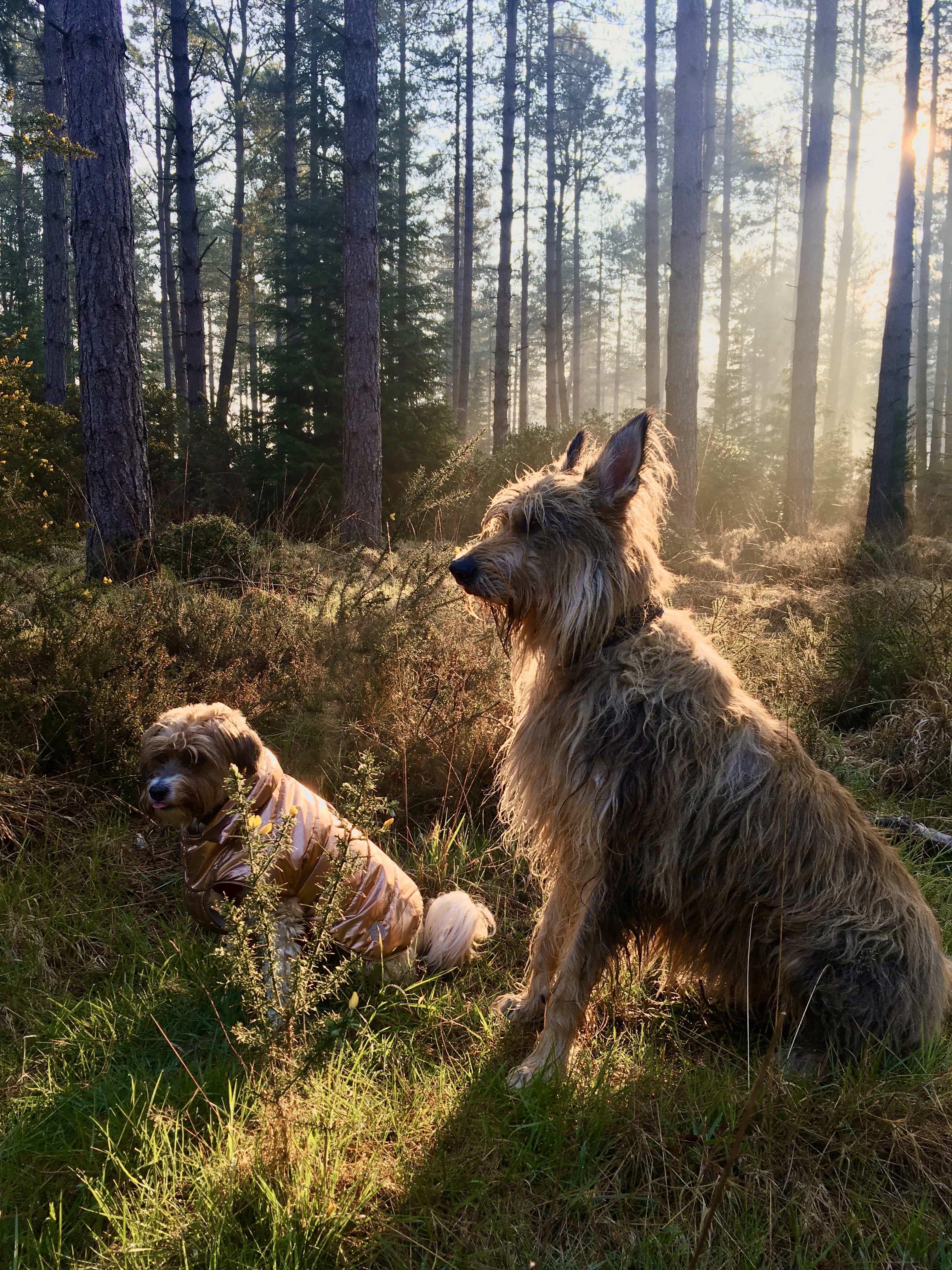
I’ll say it upfront: mistakes were made.
I was really excited to attend a herding weekend, having read about the Herding Instinct Test, and listened to a podcast about a woman in the U.S. who competes in herding with her rottweilers. I was interested to see if Indie would make the cut as a herding dog and it’s great to see a dog doing the thing that it was bred for.
When I tasked Google with finding me a herding related activity it came up with a very exciting course that seemed to fit the bill. I looked for a herding weekend and completely missed the tiny detail that what I signed up for was a Shepherding weekend.
The first weekend in May should have been warm enough to enjoy camping out in my nephew’s tiny, partly converted Nissan van. In reality it was 2°C overnight with a heavy frost in the morning. The dogs, very thoughtfully, woke me at regular intervals through the night so that I could watch the full moon, listen to the cow in the next field and take swigs of Sloe Gin before returning, fully clothed, to my blankets.
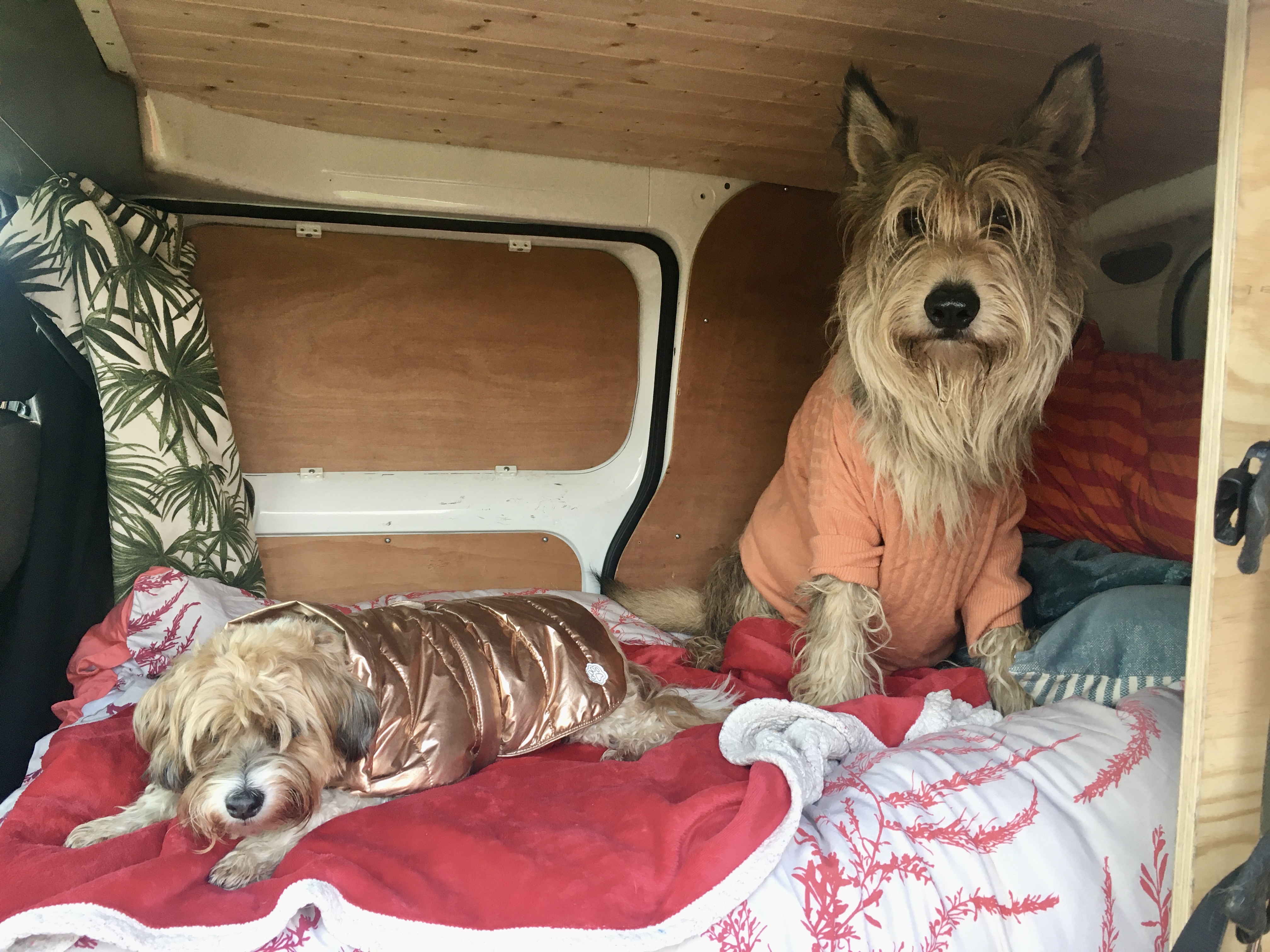
The course had a 9 am start, which gave us very little time to enjoy the glory of a deserted Wareham Forest or a leisurely breakfast afterwards. I was a little late to the start of the course, but managed to catch most of the introductory chat. As our instructor was talking, the cogs in my brain finally started to turn as I made the fine distinction that this was not a herding course and we would not be meeting any sheep. The disappointment was tiny, but the relief was huge.
Our instructor, Pat, had emptied an orchard of sheep 3 days earlier in order to reduce the chance of our dogs picking up any sheep-borne parasites, and we parked our vehicles under a line of mature trees to make the most of the shade. Pat told us that her sheep would have been terrifying to the dogs and as owners, I think we all would have been mortified if our dogs had misbehaved in any way with her livestock. Instead we were treated to the history and practice of transhumance in as much detail as we could cope with. Transhumance is a kind of pastoralism involving the seasonal droving of livestock to large pastures for grazing. The dog’s job is to guide the flock to pasture, then keep them within the area marked out by the shepherd.
Our first job as “shepherds” was to learn how to walk the walk, a distinctive kind of movement that the dog can see and recognise over a distance. That should have been easy, we’ve all been walking for years, right? It goes like this: step with the right foot, sway from the waist over to that side so that your right arm can slide a little way down the side seam of your trousers. Step with the left foot and similarly sway over to the left. Keep going. Walking is easy until you have to think about it. If nothing else it helped to break the ice and gave us all a good laugh.
After a little practise, the shepherd’s dog was was allowed to join in. The dog was given no training or guidance. I think that they really enjoyed this – a whole orchard for running, rolling around, and in at least one case, eating sheep poop. The ‘shepherd’ kept up with the swaggering walk and the dog was free to engage with and follow them. They didn’t all choose to do so. The lack of instruction was at first quite baffling and a little frustrating, but after that it was just fun. No pressure on us, no pressure on the dog.
Pat’s dogs are all German shepherds and she had not met any Picardy sheepdogs before. Seeing them larking about in her orchard made her a little emotional as she remarked that the breed seemed unspoiled and that we should never do bitesports with them. This may be a reference to how the Malinois (Belgian Shepherd) has so successfully transferred its drive from herding to sports like Schutzhund. So much so that they are sometimes referred to as “Maligators”.
After lunch we were invited to explore the use of a special shepherd crook with a spade at the tip and a hook for yanking sheep out of ditches. We all declined and ended up doing a little tracking, which is an essential part of shepherding. After leading a flock to pasture, the shepherd would mark a boundary out by walking the perimeter of the chosen area, leaving a scent trail for his dogs to follow. By patrolling this track, the dogs create a living barrier preventing the sheep from wandering off.
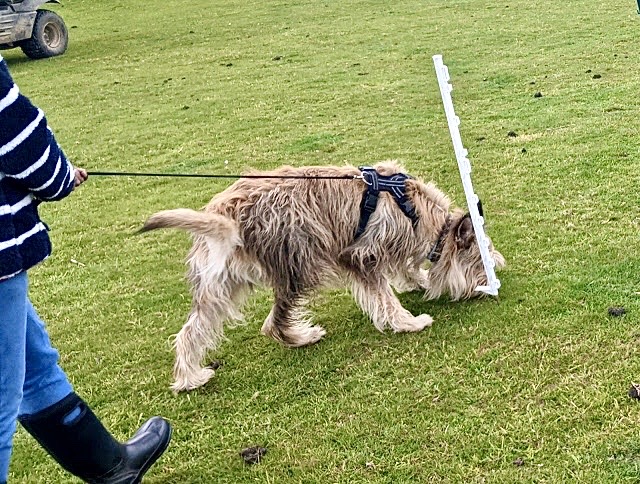
For our exercise, two uprights were placed a few metres apart. Each had a ladle attached so that treats could be placed in them by a couple of helpers. The ‘shepherd’ would hobble in the aforementioned “shepherdly” manner from one upright to the other while their dog was encouraged to also walk between the poles by the helpers dropping treats into the ladle then tapping them to attract their attention. We moved to a fresh part of the field for each dog.
We did more tracking the following day and I was quite enthused about it by the time we left. I really enjoyed the weekend: there was no pressure on us or our dogs, we got to hang out with them for the whole weekend, and we only got a little bit rained on. I had a lot to think about in the following weeks, but the thing I thought about the most is Pat’s assertion that “the dog is not wrong”. If your dog does not do the thing you want him to do, he is not wrong, there will be a reason for his action (or inaction). Does he understand what you want? Is your body language or tone of voice giving a conflicting message? Is an interesting smell taking up his attention? Does he need to pee? For me it means that when I’m training Indie and he is having an off day I don’t worry about it – he has his reasons. We play, he gets treats, we do something simple, I call it a day and enjoy my dog.
Indie and I have done no tracking since this experience, but I’d be more than happy to do it again, given the opportunity.


 Total Recall Dog Training School