Our “herding” weekend

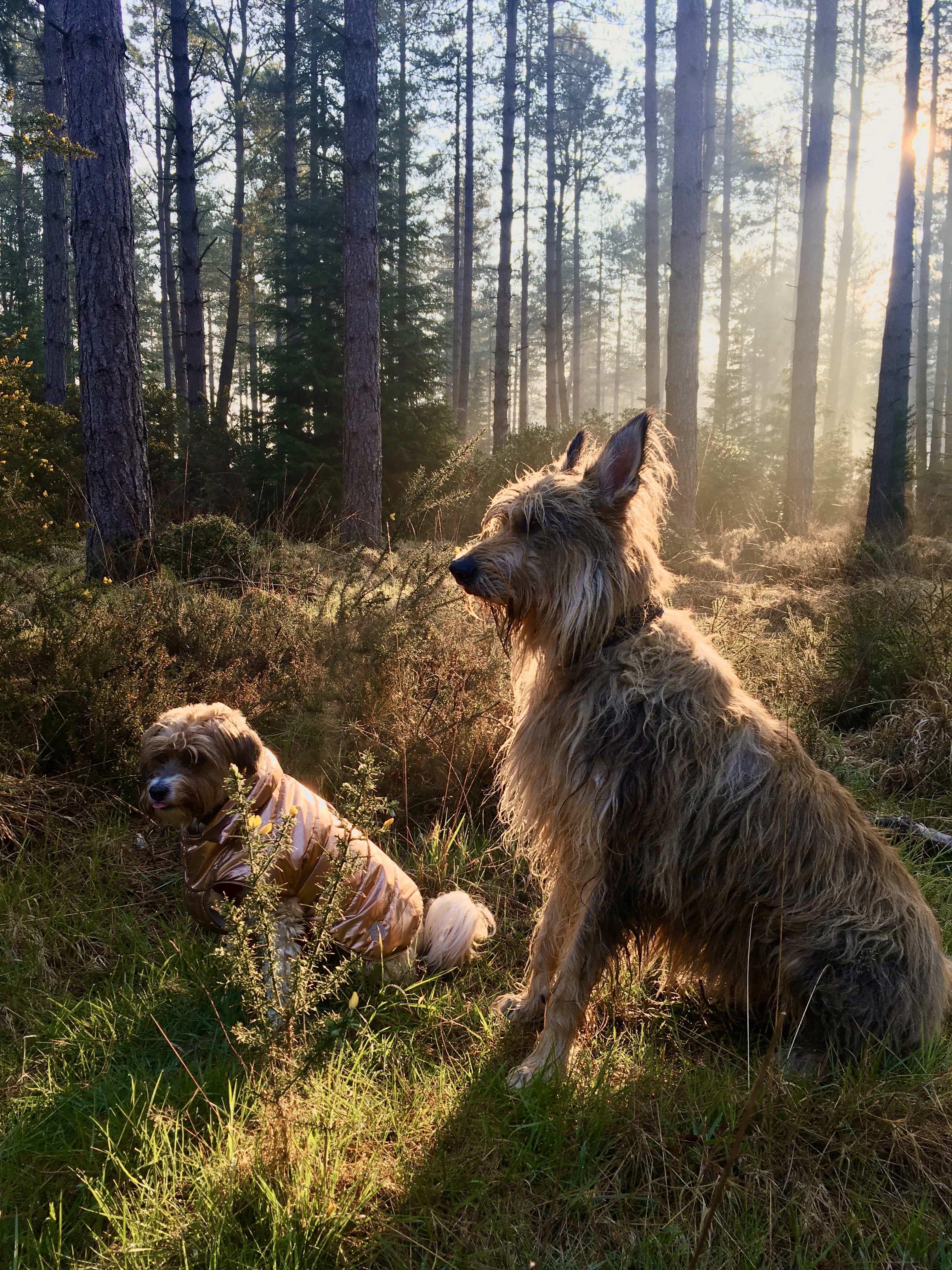
Early morning in Wareham Forest

I’ll say it upfront: mistakes were made.

I was really excited to attend a herding weekend, having read about the Herding Instinct Test, and listened to a podcast about a woman in the U.S. who competes in herding with her rottweilers. I was interested to see if Indie would make the cut as a herding dog and it’s great to see a dog doing the thing that it was bred for.

When I tasked Google with finding me a herding related activity it came up with a very exciting course that seemed to fit the bill. I looked for a herding weekend and completely missed the tiny detail that what I signed up for was a Shepherding weekend.

The first weekend in May should have been warm enough to enjoy camping out in my nephew’s tiny, partly converted Nissan van. In reality it was 2°C overnight with a heavy frost in the morning. The dogs, very thoughtfully, woke me at regular intervals through the night so that I could watch the full moon, listen to the cow in the next field and take swigs of Sloe Gin before returning, fully clothed, to my blankets.
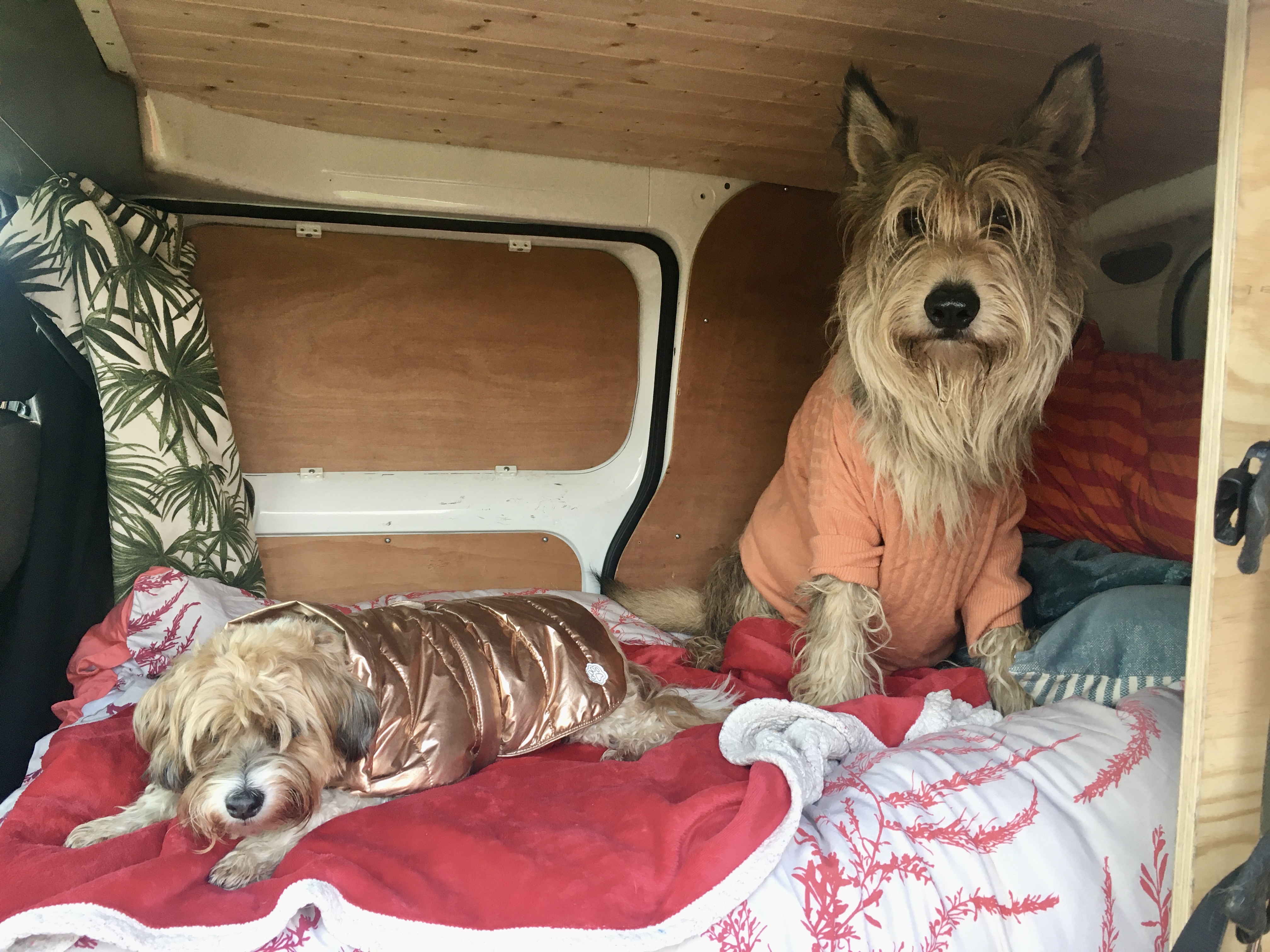
Lola and Indie keeping warm in the van

The course had a 9 am start, which gave us very little time to enjoy the glory of a deserted Wareham Forest or a leisurely breakfast afterwards. I was a little late to the start of the course, but managed to catch most of the introductory chat. As our instructor was talking, the cogs in my brain finally started to turn as I made the fine distinction that this was not a herding course and we would not be meeting any sheep. The disappointment was tiny, but the relief was huge.

Our instructor, Pat, had emptied an orchard of sheep 3 days earlier in order to reduce the chance of our dogs picking up any sheep-borne parasites, and we parked our vehicles under a line of mature trees to make the most of the shade. Pat told us that her sheep would have been terrifying to the dogs and as owners, I think we all would have been mortified if our dogs had misbehaved in any way with her livestock. Instead we were treated to the history and practice of transhumance in as much detail as we could cope with. Transhumance is a kind of pastoralism involving the seasonal droving of livestock to large pastures for grazing. The dog’s job is to guide the flock to pasture, then keep them within the area marked out by the shepherd.

Our first job as “shepherds” was to learn how to walk the walk, a distinctive kind of movement that the dog can see and recognise over a distance. That should have been easy, we’ve all been walking for years, right? It goes like this: step with the right foot, sway from the waist over to that side so that your right arm can slide a little way down the side seam of your trousers. Step with the left foot and similarly sway over to the left. Keep going. Walking is easy until you have to think about it. If nothing else it helped to break the ice and gave us all a good laugh.

After a little practise, the shepherd’s dog was was allowed to join in. The dog was given no training or guidance. I think that they really enjoyed this – a whole orchard for running, rolling around, and in at least one case, eating sheep poop. The ‘shepherd’ kept up with the swaggering walk and the dog was free to engage with and follow them. They didn’t all choose to do so. The lack of instruction was at first quite baffling and a little frustrating, but after that it was just fun. No pressure on us, no pressure on the dog.

Pat’s dogs are all German shepherds and she had not met any Picardy sheepdogs before. Seeing them larking about in her orchard made her a little emotional as she remarked that the breed seemed unspoiled and that we should never do bitesports with them. This may be a reference to how the Malinois (Belgian Shepherd) has so successfully transferred its drive from herding to sports like Schutzhund. So much so that they are sometimes referred to as “Maligators”.

After lunch we were invited to explore the use of a special shepherd crook with a spade at the tip and a hook for yanking sheep out of ditches. We all declined and ended up doing a little tracking, which is an essential part of shepherding. After leading a flock to pasture, the shepherd would mark a boundary out by walking the perimeter of the chosen area, leaving a scent trail for his dogs to follow. By patrolling this track, the dogs create a living barrier preventing the sheep from wandering off.
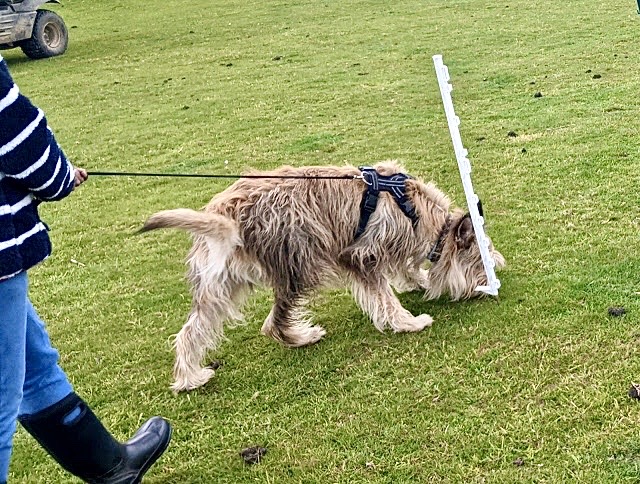
Indie doing what comes naturally – tracking

For our exercise, two uprights were placed a few metres apart. Each had a ladle attached so that treats could be placed in them by a couple of helpers. The ‘shepherd’ would hobble in the aforementioned “shepherdly” manner from one upright to the other while their dog was encouraged to also walk between the poles by the helpers dropping treats into the ladle then tapping them to attract their attention. We moved to a fresh part of the field for each dog.

We did more tracking the following day and I was quite enthused about it by the time we left. I really enjoyed the weekend: there was no pressure on us or our dogs, we got to hang out with them for the whole weekend, and we only got a little bit rained on. I had a lot to think about in the following weeks, but the thing I thought about the most is Pat’s assertion that “the dog is not wrong”. If your dog does not do the thing you want him to do, he is not wrong, there will be a reason for his action (or inaction). Does he understand what you want? Is your body language or tone of voice giving a conflicting message? Is an interesting smell taking up his attention? Does he need to pee? For me it means that when I’m training Indie and he is having an off day I don’t worry about it – he has his reasons. We play, he gets treats, we do something simple, I call it a day and enjoy my dog.

Indie and I have done no tracking since this experience, but I’d be more than happy to do it again, given the opportunity.
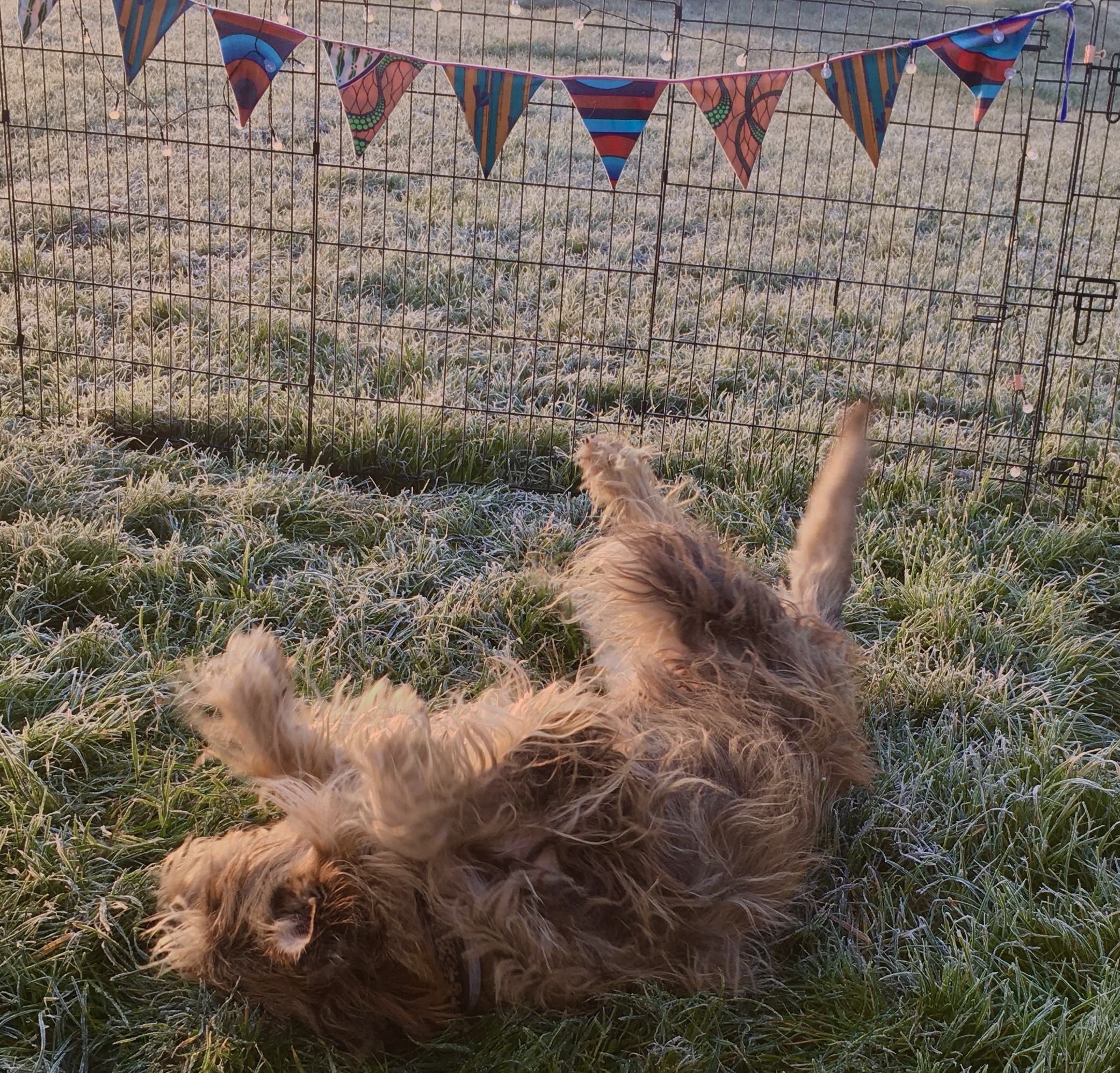
Indie can never resist rolling in the frost

Posted in Dog Training | Tagged , , , , , , , , , , | Leave a comment

Lola’s tummy troubles

As Lola has trundled on towards senior status, I’ve been looking out for symptoms that typically come on in old age. When I noticed that she no longer carried her tail curved over her back I was alarmed, then sad, then accepted it as inevitable, although I hadn’t known that it could happen. At the age of eleven she began to walk more and more slowly. It got to the point where it was difficult crossing roads within the time available at pedestrian crossings. One morning, not far from home, I let her off lead in a park to wander and sniff. When it was time to continue, she refused to move. I put her lead on and took a step in various directions to entice her onwards and the only direction that appealed was the one that led home. I took her back, then continued the walk with just Indie.

Assuming she had some joint pain I added supplements to her food and gave up on regular walks. From then on, when we were about to take a walk I would pick up her lead and wait to see what she wanted. Her way of saying no was to back up a couple of steps and sit down.

I’ve taught human Anatomy and Physiology for a number of years at different levels, and due to a set of circumstances ended up in charge of Surface and Living Anatomy at an Acupuncture College. I’m used to identifying anatomical landmarks and had noticed some years previously that I could easily palpate Lola’s linea alba. On humans this is the vertical depression made of connective tissue that joins the left and right sides of the abdominal muscles. You only really notice it as part of a six-pack on a very well developed, muscular abdomen with little to no fat over the top.

One day Lola had a bad tummy and threw up part of her breakfast in the garden. I was standing over her to make sure she was okay and noticed that her abdominal muscles were bunching up weirdly along her sides. I was aware that women can suffer from diastasis recti during pregnancy, where the left and right abdominal muscles separate. I didn’t know it could happen to dogs. The ideal next step would have been to visit the vet for confirmation, but this happened mid-2020 and vets were only open for emergency consultations. Online, I found other dog owners who confirmed that this had happened with their own dogs and there was no remedy for the condition.

The one thing I thought might help was to offer some support for the abdominal organs that would usually be held in place by a healthy muscle wall. So I made her a stretchy, close fitting vest. The first one was a patterned cotton with lycra, but it needed more stretch. Then I found some fabric with “4-way stretch”, like swimming-costume fabric. It was supportive and firm, but easy to get on and off. I made three so that I’d have spares for days when Lola rolls in something mucky. Luckily she has never minded being handled or dressed-up and co-operates when I need to put something on her. It seemed to do the trick and reignited her joy of walkies. She’s still a little slow, and spends a ridiculous amount of time sniffing, but we have adapted to that. I also made a little step to help her get up onto the sofa. She completely ignores it.

Photo: Peter Jones Photography
Posted in Uncategorized | Tagged , , , , | Leave a comment

Indie’s First Show

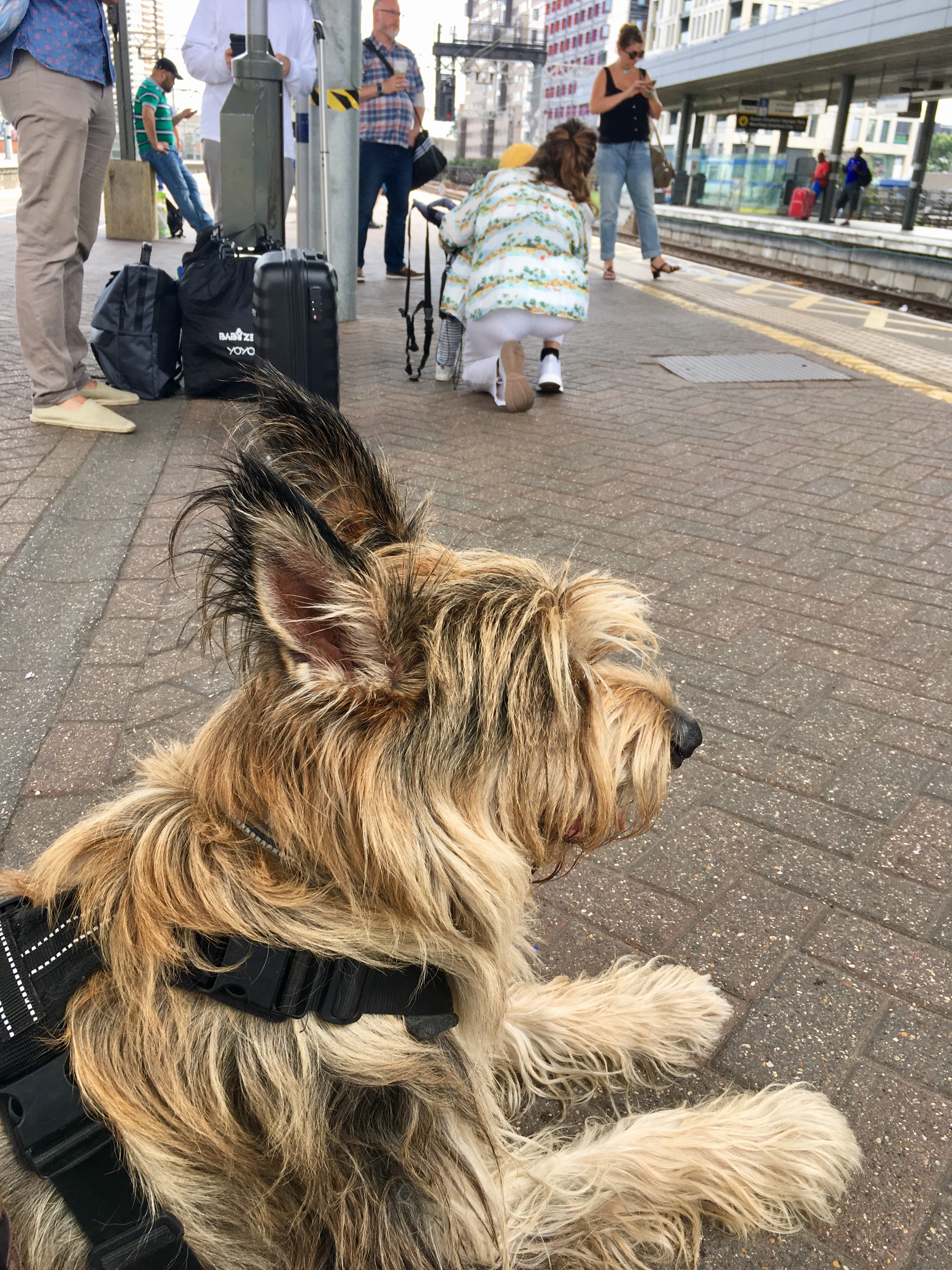
Waiting for our train

I train Indie at home with no other dogs around. We use a local public sports area, so there are plenty of other distractions such as commuters, refuse lorries, emergency vehicles and lots of trains from a nearby mainline train station, just no dogs. Indie loves dogs and displays an indecent amount of excitement to meet them all.

We mainly train obedience exercises and I really wanted to see how he would work in a busy show environment in close proximity with lots of other dogs and people. Instead of the formality of an official Kennel Club Obedience competition, I thought the best way to dip our toes in the water would be a Companion Dog Show. These offer obedience competitions run by Kennel Club rules but independent of the official shows.

As usual, there were none available in London, so we headed off to Essex via public transport. I packed water, food, treats, toys and a familiar mat for Indie’s comfort. For each stage of the day – the underground, the train, the show itself – my mantra was “if he doesn’t like it we can just go home”.

The weather was warm and sunny as we arrived at the show and booked in near the entrance. I found us a spot under some trees and settled down to observe my dog. I was stressed at this point but couldn’t tell from Indie’s panting whether he was stressed, excited or just hot.

“Are we calm yet”

After a rest I realised that his mood was not changing. He seemed neither more, nor less agitated than when we arrived, so we took a tour around the field. There were rings for the four levels of obedience on offer, an area where scent cloths were laid out for more advanced obedience, a fun Agility ring, a Rally Obedience area, stalls selling dog toys and food – all centred around the dog breed arenas. I tried another strategy to chill my dog out by having a go at some low-stakes activities. We did a round of the Agility and struggled through some Rally Obedience. I still have no clue whether we did okay or not.

Finally I became resigned to Indie not calming down and turning in a decent performance. I thought we may as well try a round of obedience since we were there and I had no expectations of him. I wish I could say his performance was stunning. It was adequate. I was proud of him for coping with the crowds and hordes of dogs. He seemed to actually enjoy his day out even though he never lifted out of a light stupor of overstimulation. I wanted to wait for the final result, but realised that a train was about to leave the station and the service only ran once an hour, so we made a run for it, met the train and went home.

I didn’t know if I’d ever find out how well we did in our rounds, but was thrilled to receive a very handsome rosette and a card in the post a week or so later.

The lesson I should have taken away from this is that if your dog is overstimulated in a new, busy environment, it is pretty unlikely that you will be able to get him to settle down and find some calm and focus. We attended another companion show before having a go at an official obedience trial and Indie slowly learned to settle down and take things in his stride. I did learn that these shows hand out some gorgeous rosettes. The cakes they sold weren’t bad either.

Whether or not these experiences have a positive outcome depends on the individual dog and exactly what happens on the day. Happily for us, Indie enjoyed his day out and shows it by trying to drag me into the train station every time we walked past it.

He looks very proud, but really he’s just seen a dog in the distance

On Facebook, groups with names like Companion and Fun Dog Shows will list shows in your area. Obedienceuk.net lists schedules for obedience competitions and companion shows and costs £10 per year to join.

Posted in Uncategorized | Tagged , , , , | Leave a comment

TEAM Obedience at Fenzi Dog Sports Academy

In 2016 Fenzi Dog Sports Academy started an online dog obedience titling scheme called TEAM titles. It stands for Training Excellence Assessment Modules. You teach your dog various exercises at home, video them and submit the video for judging. After a week or so, you get the result (pass or not yet) along with helpful comments from the judge. This set-up suits me perfectly. I don’t need to travel anywhere to participate and it only costs around £15 to register and £22 to submit a video ($20 and $29 November 2021).

Indie already had some of the skills needed to start the necessary exercises as we had been working on Sue Ailsby’s Training Levels. Happily a course was offered at FDSA for TEAM levels 1 and 2 – this was later divided into separate courses as there were enough students to fill them. I wasn’t familiar with the use of platforms and perches in training, so I got my power tools out and used leftover wood from my campervan refit to make a small platform for sitting and a larger one that Indie could lie on. I needed a very heavy, solid perch for him to pivot round, so I wrapped my copy of Larousse Gastronomique securely in brown paper and packing tape and hoped for the best.

Looking back, I’m not sure how we managed to learn all of the exercises – including jump over a hurdle, in my tiny sitting room. The maximum space in there is 3.3m by 3.9m (11 x 13ft). Once Indie was fluent in all the behaviours and I felt we were close to submitting an attempt, I tried to video the sequence of 10 exercises and found that even if I placed the camera and tripod outside the back door and used a fish-eye lens, I wasn’t able to get all of the action into the frame. The only option was to find a new space and retrain everything. The good news: we have an enclosed sports area on the estate. The bad news: no dogs allowed.

There was a lot of equipment to ferry backwards and forwards: two platforms, perch, cone, jump, vertical target and scent articles. Although no-one challenged our presence in the space, Indie had a lot of distractions to work around. We are near a major rail terminus and the tracks run over the other side of the road. Commuters and school children walk past, chatting; there are businesses in the railway arches that make pizza and other food for delivery; lorries come to empty the communal bins and there are the ever-present background noises of planes and emergency vehicles.

All 10 exercises have to completed in a single video with a time limit of seven minutes. This has since changed so that you can split the exercises into two sets of five, videoed a maximum of 7 days apart.

Our first submission earned a “Not yet” due to handler error, but two weeks later our we earned a pass and the exhilaration of achieving it kept me buoyed up for weeks.

Posted in Dog Training | Tagged , , , , , , , | Leave a comment

Liver Cake Recipe

Many people have their own favourite Liver Cake recipe, this is mine. A dozen years back there was an easily accessible resource of dog treat recipes on the internet – just the recipes – no cute anecdotes, no declaration of how important that recipe was to that person. I tried a couple of the other recipes, but this is the one that I stuck with.

The proportions are pretty general 1 part flour to 3 parts liver, so it’s easy to scale up or down, or swap in different grains or proteins. I’ve made it with tinned fish instead of liver or non-wheat flours. If you use something like rice or potato flour, sift in a teaspoon of baking powder.

Ingredients
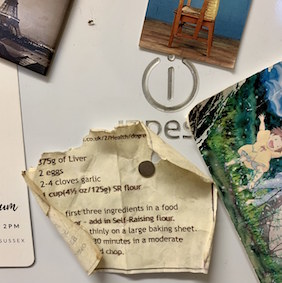
375g Liver
2 eggs
2-4 cloves of garlic
125g self-raising flour

Method

Heat oven to 180ºC/ 350ºF/ Gas mark 4.

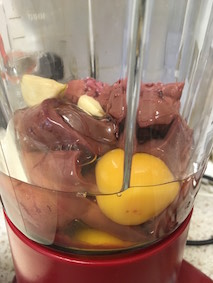
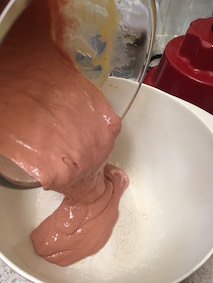
Line a large baking tray with non-stick parchment or a silicone mat. Whiz together the first three ingredients in a food processor or goblet blender until smooth. Do not fill the blender more than half full.

Scrape into a large bowl and stir in the flour. If you don’t sieve the flour you will probably have little white spots of flour left in the finished product. The dogs won’t mind.

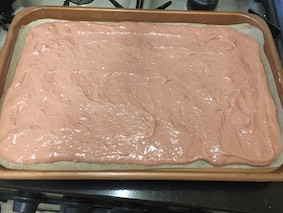
Spread onto baking tray to a thickness of half an inch or just under a centimetre. Making the layer too thin will prevent the cake from rising. Bake around 30 minutes until the cake is risen and firm. If the underside looks damp, turn the cake over and return to the oven for 5-10 minutes.

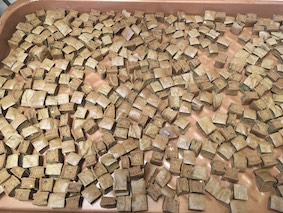
Turn onto a cooling rack. From here you can let the cake get completely cold, cut into cubes and freeze most of it, keeping back the amount you will use in 3 days. Or, when its’ cool enough to handle, cut into cubes and return to a low oven to ‘toast’. When you squeeze a cube in your fingers and it only compresses a little (or not at all), let the cubes cool and you can bag them up and keep them in the cupboard. I usually freeze half and dry half. The squishy fresh/frozen cubes are more aromatic and generally more irresistible to dogs. The toasted ones are just more convenient as they have excellent keeping properties and you can just grab a handful to take with you on a walk or training session. Fresh liver cake will go mouldy after about three days and get sticky.

Fresh, cubed liver cake
After toasting
Posted in Make it | Tagged , , , | Leave a comment

Yeeha! Barrel racing is rodeo for dogs

Barrel racing

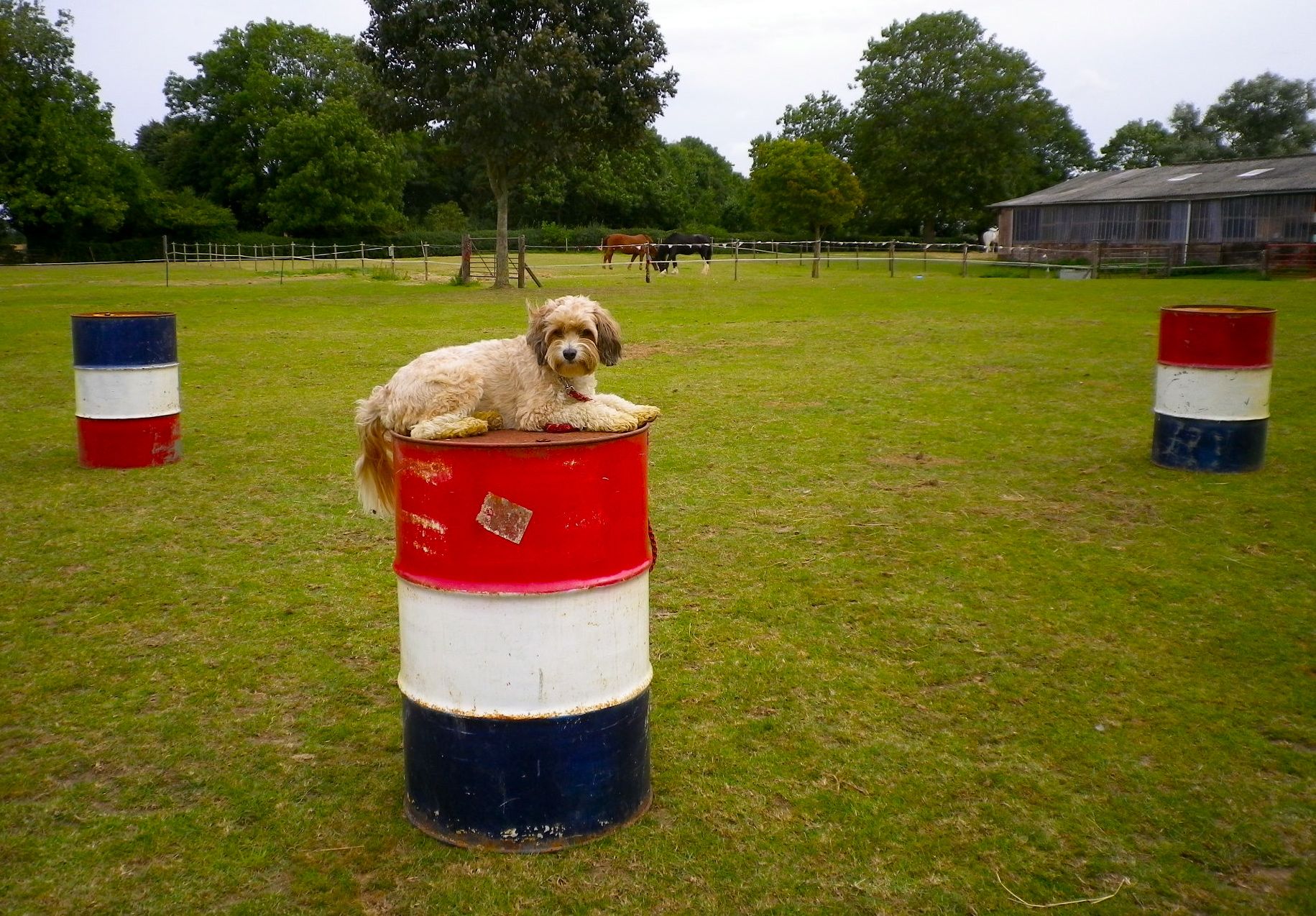
Lola rests on a barrel while planning today’s mayhem.

The most surprising thing we did this summer was barrel racing. I had to google it to be sure that the dogs do not somehow have to power the barrel around a course like a hamster in a ball. The sport is a direct steal from rodeo where horses are ridden in a clover-leaf pattern around three barrels against the clock. Having discovered this I took pains to ensure that Lola knew her way around a rubbish bin in the park, some trees and a post.

barel racing cloverAt the start of our barrel racing session held by the Ichthus Canine Centre I was asked if Lola could do both clockwise and anti-clockwise circuits. Ummm. Turned out that Lola’s turns are like Lola’s ‘roll over’ – one way only. I hadn’t noticed until this point that Lola is happiest going clockwise. Typically for her, learning a new direction would probably take around a week to be reliable. As if this were not handicap enough, Lola chose this moment, our first run-through, to be totally distracted by a horse which was being ridden past a hedge two fields away, and sprinted away barking her head off. My only solace was that having reached the far hedge to find that the exciting visitors had gone, Lola came bounding back through fields of (stationary) heavy horses on a single command. I experienced a strange, contradictory combination of mortification and pride. My feelings shifted sharply towards mortification during our second attempt around the barrels. The Centre has a lot of volunteers who come to help out at the weekend, many of them young girls. A few ponies were being moved to another field and the girl leading one of them dropped the reins and her pony made a break for it. Off went Lola for a speedy re-run. Although it didn’t take long for order to be restored I couldn’t afford to have Lola practise this reckless behaviour for a third time, so we ended the session on-lead.

What I like about barrel racing is that it needs minimum equipment and only a couple of commands. Instead of barrels you can use cones, bags, bins, or conveniently placed trees, so it’s an activity you can practise wherever you happen to find yourself. We have continued to practise in the park and Lola has now mastered anti-clockwise pass now and we are trying to build a little speed.

Posted in Uncategorized | Leave a comment

Lola’s Tricks

Lola waits for ball

I have a video featuring my first dog – a Poodle x Jack Russell puppy who prematurely came to a very unhappy end. I write that lightly, but the event itself was the most upsetting thing that has happened to me. More affecting than the death of close relatives. Friends in the park have told me how sad the film is, so I promised to make a happier one featuring my current dog.

This is Lola’s showreel of many of the cues she knows. I’ve used clicker training to shape or lure her towards a behaviour, then when she can do it reliably I give the behaviour a name. Sitting was a good easy one to start with. Once she knew what I wanted her to do and did it repeatedly I linked the action to the word by saying ‘sit’ just as her bottom hit the floor. Once she did it at home, we tried it in other places with or without the lead on. ‘Sit’ came really easily and she was pretty reliable from 9 weeks old. ‘Roll over’ took longer and it was a whole year before she did it anywhere but at home.

Videoing these was a good way to see what she knew well and what needed more work. The leg weaves had briefly been very good, so I’m not sure what went wrong there and I’m surprised that ‘go to crate’ worked so well as we never use it.

Don’t expect fireworks – she’s not a flashy dog. We’ve just done the basics and a few that are more fun. It’s a way to have fun together and use up a lot of treats.

http://www.youtube.com/watch?v=I1aJ_PgfywM

Posted in Uncategorized | Tagged , , , , , , , | Leave a comment

Our first Level 1 Graduates

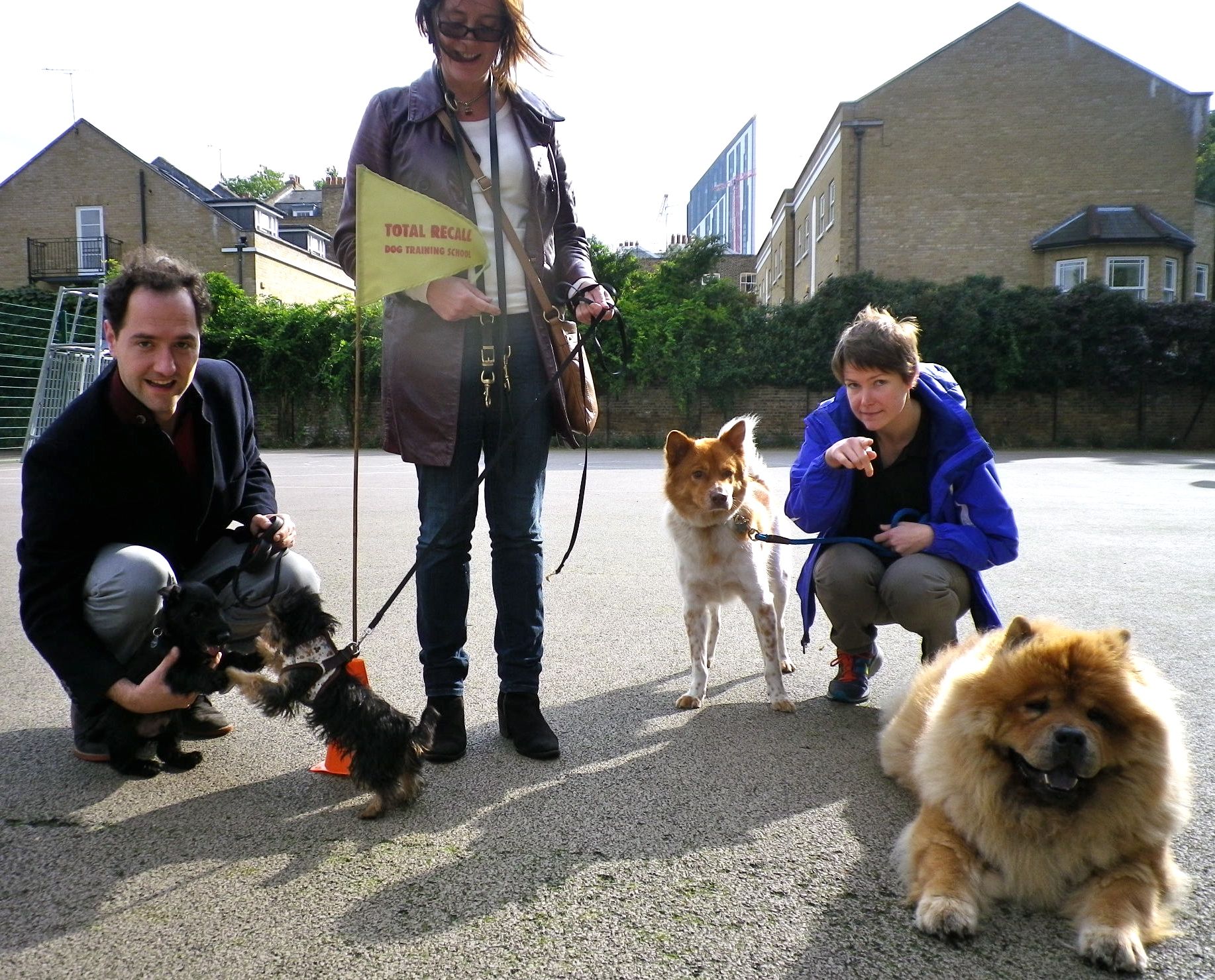
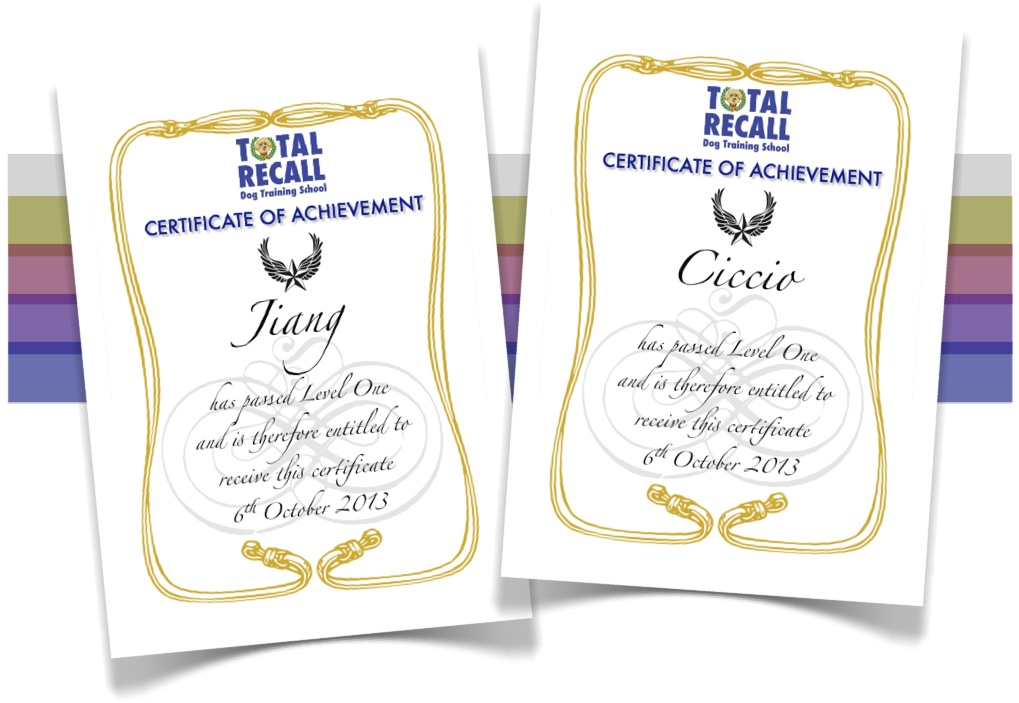
I am very happy to announce that the first two dogs have passed Level 1 and earned their certificates. Nicola Barton’s Jiang and Tess Callaway’s Cicco were proud to receive their awards last Sunday 6th October.

level 1 group

Solke with a barely visible Freddy, Nicola is holding little Mia, Tess shows Ciccio where the camera is
and Jiang is too cool for school.

Level 1 is a foundation course for both the dogs and their owners. By starting to learn some basic good behaviour the dogs will find it easier to learn new things in the future. Their owners get a grounding in how dogs learn and how to deliver a treat with precise timing so that the dog knows exactly what it did right.

Jiang and Ciccio are now able to ‘sit’ and ‘down’ on a single verbal command or visual signal. We tested them on the verbal command by making sure they performed perfectly even when they couldn’t see their owners face or if Nicola or Tess were lying on the ground. Sometimes when dogs follow a command, they are picking up on body language or environmental clues without really understanding what the word means.

Level 1 dogs also begin to learn the command ‘leave it’ and are able to ignore a treat held in an open palm. One of the most important things a dog should do is come back when called. This is such a difficult thing to do when there are distractions around that at this stage we only require that they play a game of running between two people for treats. They also learn to follow outstretched fingers and touch them with their nose. I use this to re-position Lola when we are traveling on the tube, or if we’re in a cafe, but its a good skill for dogs training in obedience or agility.

certificatesComing up in Level 2: Ciccio and Jiang learn ‘stay’, ‘watch me’ and a party trick of their choice.

Posted in Uncategorized | Tagged , , , , | Leave a comment

Fun at the dog shows

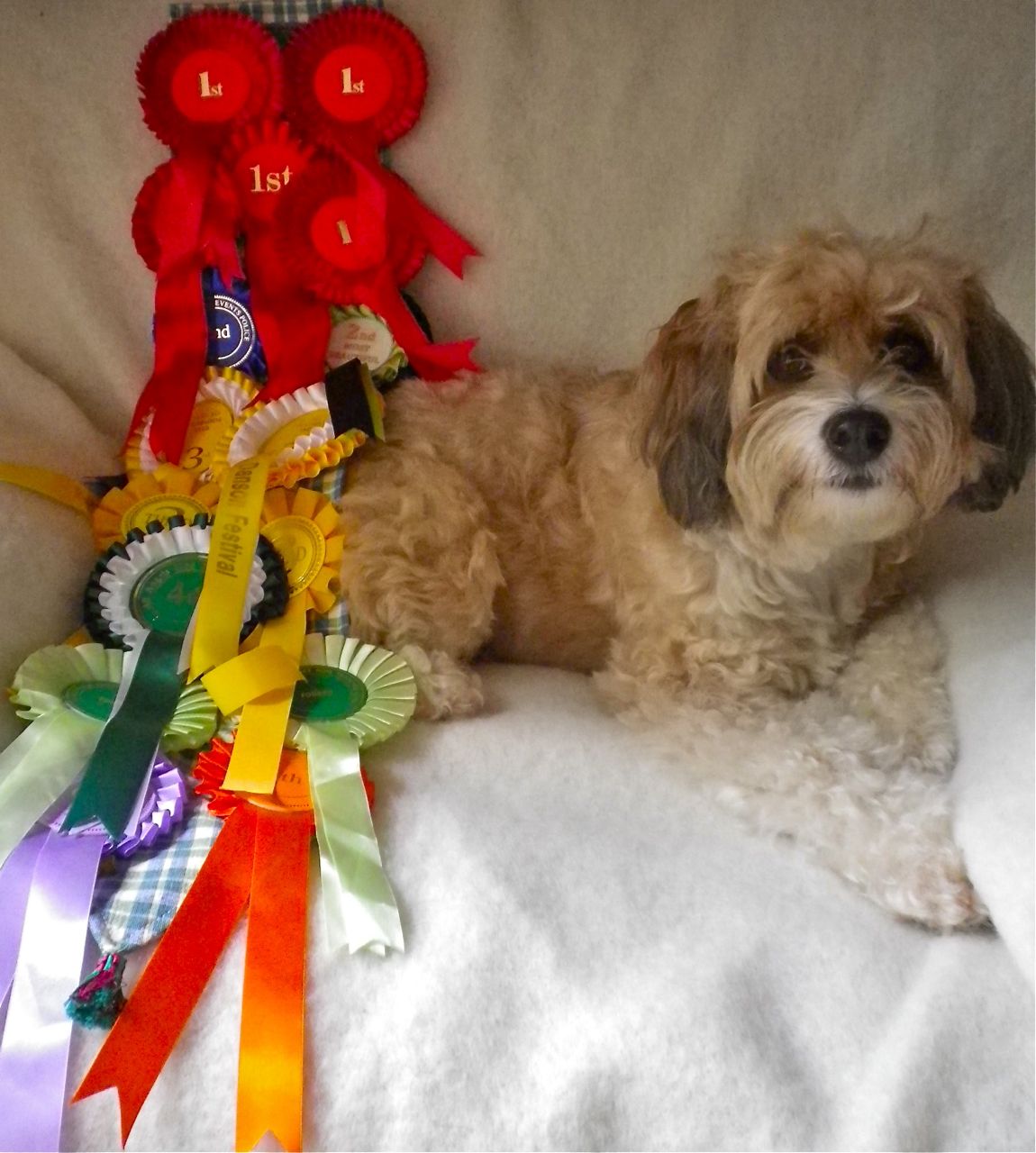
Lola ribbons

Lola-dog poses regally with her rosettes.

I entered Lola into her first Fun Dog Show when she was 9 months old. Seemed like it might be fun. At that stage she was eligible for the Best Puppy category and I thought I could also rustle up a fancy dress costume.

On the day I was surprisingly nervous. There were so many puppies entered that separate rings were provided for the male and female pups and there were 40 entries in each. We were a bit late, so I ducked under the rope and found a space to show off my freshly washed puppy. Looking around I could immediately see we were doomed. There was a beautiful husky with blue eyes, tiny fluffy spaniels and leggy, winsome labradoodles. Lola never stood a chance as she wasn’t classically ‘cute’ – she’s always been a bit too independent and aloof. By the time the judges (the local vet and his assistant) came to us they’d used up all of their small-talk on the little blond kids and their tiny canine best friends, and we exchanged only a desultory handful of words. As soon as they moved away to the next pair we ducked back under the ropes and wandered off. It’s one of those character-building experiences to be reminded that everybody’s puppy is the best puppy.

And as we continued to attend these events that’s not all we learned. The loose rule of fun dog shows is that: “you can’t win against a child handler or a 3-legged dog’. This I learned after a 3-legged dog took home every rosette from a show in Hyde park. The ‘child handler’ bit explains itself. Somehow, these are always the entries I end up standing next too. The most obvious lost cause was during the summer of the London Olympics when I found myself alongside a retired police sniffer dog with crippling arthritis, whose wheelchair was decked out patriotically to represent the British murderball team. I chatted to the dog’s owner for a while, then sighed deeply and put on my best beauty pageant smile. Lola and I did not make the cut.

Most fun, companion, or novelty dogshows run through the summer from May to September and it’s a great way to spend a summer afternoon. Share the experience with friends, or take a picnic. If the event is also hosting a breed show the classes can be a lengthy drawn-out process as judges wait for handlers who are attempting to show in two rings simultaneously. Take something to sit on, snacks, water, grooming tools for your beautiful dog or props for your clever dog’s tricks and maybe something shady if it’s very hot. Lola never entered a show as a puppy again, but she’s won rosettes for being pretty, trying to march, catching treats, doing tricks and being slightly more obedient than some  other dogs. I think we have enough now. We will continue to enter competition obedience shows though, and maybe one day earn a ribbon in a recognised dog sport.

If you live in London one of the best ways to find shows and other dog events is the London Dog Forum, a website with a lot of useful information for dog owners. A Yahoo group called ‘Fun’ Dog Shows lists companion shows on its database and Cobbydog (a dog food company) have a similar list, although few of these occur in London.

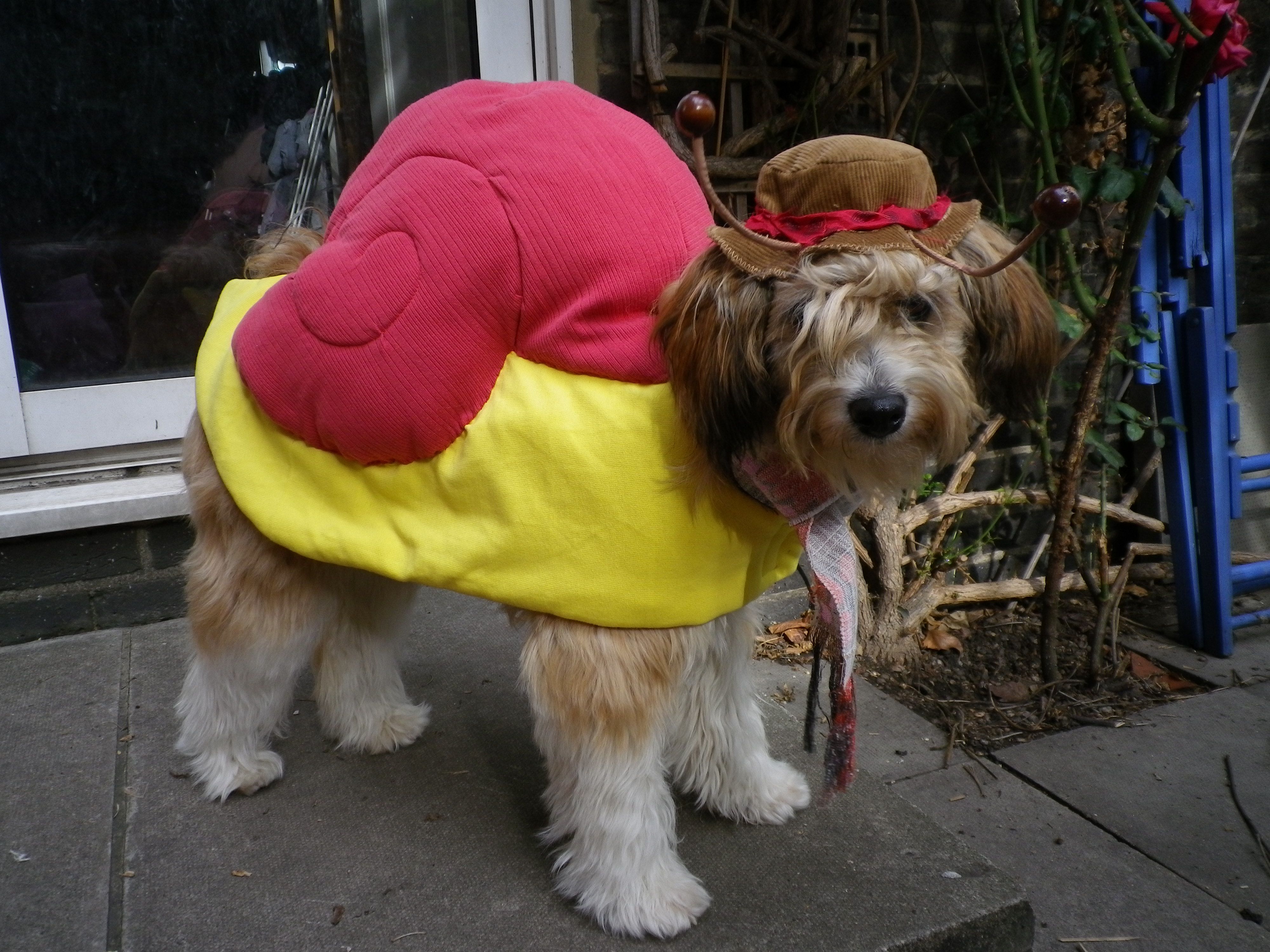
For those who are wondering what Lola’s fancy dress costume was like, here she is, resplendent as Brian the snail from The Magic Roundabout.

Lola as Brian2

This is Lola as Brian the snail from The Magic Roundabout. Or possibly “Dougal dresses up as Brian the snail”.

Posted in Uncategorized | Tagged , , , , , | 1 Comment

How about a little Heelwork to Music?

Lola and pony

Lola says hello to a pony at Northcote Heavy Horse Centre

Lola and I were lucky enough to take part in a dog activity weekend recently, allowing us to try out a variety of dog sports. We experienced a jamboree bag of doggy activities including agility, Competitive Obedience, Rally Obedience, Nosework, Flyball, Barrel Racing and Heelwork to Music (HTM), all run by Ichthus Canine Centre and hosted by the Northcote Heavy Horse Centre in Spilsby, Lincolnshire.

One of the leaders of the weekend, Christina Oxtoby, specialises in Heelwork to Music (HTM) and competes at an international level. I’ve always been resistant to this particular canine activity – too mentally scarred by images of handlers dressed in cowgirl outfits moving awkwardly to country and western music and rolling around on the floor. When I looked back at the history of the activity I was surprised to find that it originates in the world of Obedience. The story goes that the great Obedience handler, Mary Ray, was asked to demonstrate her dogs’ talents to an audience and devised a routine to fit the length of a particular piece of music. At that point the display consisted purely of various types of heelwork, but over the years the sport has developed to include more freestyle moves. Happily it is only the handler who dresses up; the dog needs no embellishment.

Like most dog activities, HTM requires that your dog has a basic level of obedience. She should be able to follow instructions such as ‘sit’ and ‘down’ and move around in heel position (at the left side of the handler). Using a good supply of dog treats Christina started us off with simple movements, getting the dog to turn in an anti-clockwise direction whilst in heel position. We progressed to a couple of different leg weaves and an attempt to make our dogs walk backwards away from us. This was much more my kind of thing! After telling Christina how I’d been trying to perfect Lola’s play bow since Christmas, she showed me a way of luring it which worked really well.

If your dog already has a few tricks up her sleeve you can build on them to develop an HTM routine. If she will ‘shake hands’ you can encourage her to cross paws by cueing this trick when she is already lying down. Lola can already jump through my arms, but I’d love to get her to jump up and vault off me. Christina’s dog does this beautifully.

I  still have no plans to put what I do with Lola to music, but I am very encouraged to continue working on the individual moves with her. Getting her to sit up and beg will be great for her abdominal muscles and I plan to jump her over hurdles (gradually increasing the height) to build her overall strength.

A session like this is very tiring for the dog, so when all the handlers and dogs had reached their limit, Christina ended by showing us elements of her latest routine with her Border Collie Eze (Ezekiel).  http://www.youtube.com/watch?v=-503TIqpkXU

If after watching the video you’d like to learn a little more about HTM, Good Boy Dog School in Barnet is hosting an Evening with Mary Ray on 31st October 2013.

Posted in Uncategorized | Tagged , , , , | 1 Comment